
Understanding Continuous Emission Monitoring Systems (CEMS): A Complete Guide for Industrial Compliance in Gujarat (2026)
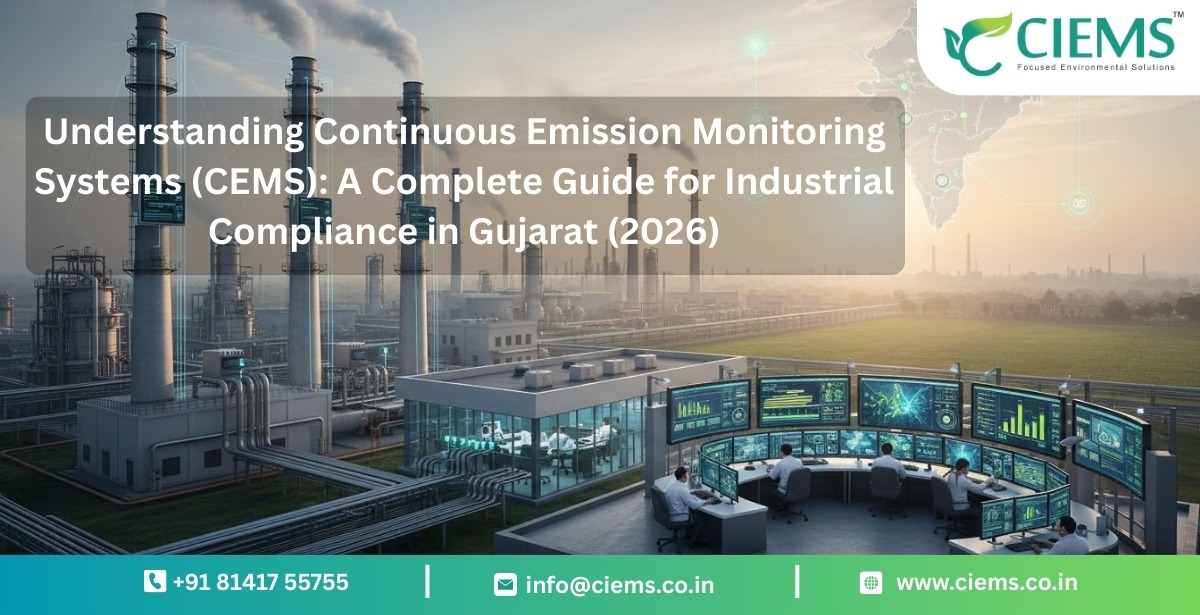
As we enter 2026, the industrial landscape in Gujarat is undergoing a digital revolution in environmental governance. The Gujarat Pollution Control Board (GPCB) has significantly tightened its grip on real-time data monitoring, moving away from periodic manual sampling to a “transparency-first” model. For industries operating in India’s manufacturing hub, Continuous Emission Monitoring Systems (CEMS) is no longer just a technical recommendation—it is a license to operate smoothly.
Whether you are managing a Chemical plant in Vapi, a Textile unit in Surat, or a Pharmaceutical hub in Ahmedabad, understanding CEMS is critical to avoiding heavy penalties and “Closure Directions”.
What is CEMS and Why does it matter in 2026?
A Continuous Emission Monitoring System (CEMS) is an integrated assembly of hardware and software designed to measure gas or particulate matter concentrations and emission rates from industrial stacks in real-time. Unlike manual testing, where a sample is taken once every few months, CEMS provides a 24/7 online stream of data.
In 2026, the GPCB and CPCB (Central Pollution Control Board) have integrated advanced AI-driven analytics into their servers. This means that any “data gap” or “emission spike” is flagged instantly, often triggering an automated notice to the industry.
The core components of an effective CEMS:
To remain compliant, your CEMS must be more than just a sensor; it must be a robust system. A standard compliant setup includes:
- Sampling Interface: Probes and pumps that extract gas from the stack.
- Gas Analyzers: These measure specific pollutants such as Sulfur Dioxide (SO₂), Nitrogen Oxide (NO₂), Carbon Monoxide (CO), Carbon Dioxide (CO₂), and Particulate Matter (PM₁₀ / PM₂.₅).
- Data Acquisition & Handling System (DAHS): The “brain” of the system that collects data, formats it according to GPCB protocols, and transmits it to the central servers.
- Calibration Units: Automated systems that ensure the analysers remain accurate over time.
The GPCB Mandate: Who needs to comply?
Under the current 2026 guidelines, CEMS installation is mandatory for the “17 Categories” of Highly Polluting Industries and those classified under the “Red Category.” Key sectors in Gujarat currently under the scanner include:
- Chemical & Petrochemicals: Focus on Volatile Organic Compounds (VOCs) and Sulfur Dioxide ((SO₂).
- Cement & Power Plants: Heavy monitoring of Particulate Matter (PM₁₀ / PM₂.₅) and Nitrogen Oxides (NO₂).
- Pulp & Paper: Monitoring of total reduced Sulfur.
- Common Effluent Treatment Plants (CETPs): Though liquid-focused, their incineration units require air emission monitoring.
Note: GPCB now requires a minimum of 85% data availability per month. If your system is down for maintenance, it must be reported immediately to avoid being flagged as “non-compliant”.
Steps to Successful CEMS implementation in Gujarat:
Implementing CEMS can be daunting, but following a structured roadmap ensures you don’t waste capital on the wrong technology.
- Site Assessment and Selection
Not all stacks are the same. Factors like flue gas temperature, moisture content, and stack diameter determine whether you need an Extractive System (gas is pulled to a ground-level analyzer) or an In-Situ System (analysis happens inside the stack).
- Meeting NPL-India Standards
The government now strictly mandates that CEMS equipment must be certified. Using non-certified, low-cost sensors often leads to data rejection by the GPCB, resulting in the need for expensive replacements.
- Seamless Data Integration
Your DAHS software must be compatible with the GPCB Real-time Environmental Data Monitoring (RETM) portal. In 2026, cybersecurity protocols for data transmission have been updated, so ensure your software provider is compliant with the latest encryption standards.
- The importance of AMC (Annual Maintenance)
CEMS are sensitive instruments operating in harsh environments (heat, dust, and corrosive gases). A regular maintenance schedule is the only way to ensure 24/7 uptime and data accuracy.
The benefits beyond Compliance:
While the primary driver for CEMS is legal necessity, smart industries in Gujarat are using this data for Process Optimization. Real-time monitoring allows plant managers to:
- Identify fuel combustion inefficiencies.
- Reduce raw material wastage.
- Improve the lifespan of Air Pollution Control Devices (APCD) like Scrubbers and Bag Filters.
Conclusion:
The era of “approximate” environmental reporting is over. In 2026, your emission data is your reputation. For Gujarat’s Industrial Sector, CEMS is the most vital tool in the journey toward Sustainable Manufacturing.
A faulty CEMS installation is often worse than having no system at all, as it provides a false sense of security while sending incorrect data to the regulators. Partnering with experts who understand the local GPCB landscape is essential for long-term peace of mind.
Is your facility ready for the next GPCB audit?
Contact CIEMS today for an end-to-end Environmental Site Audit.