
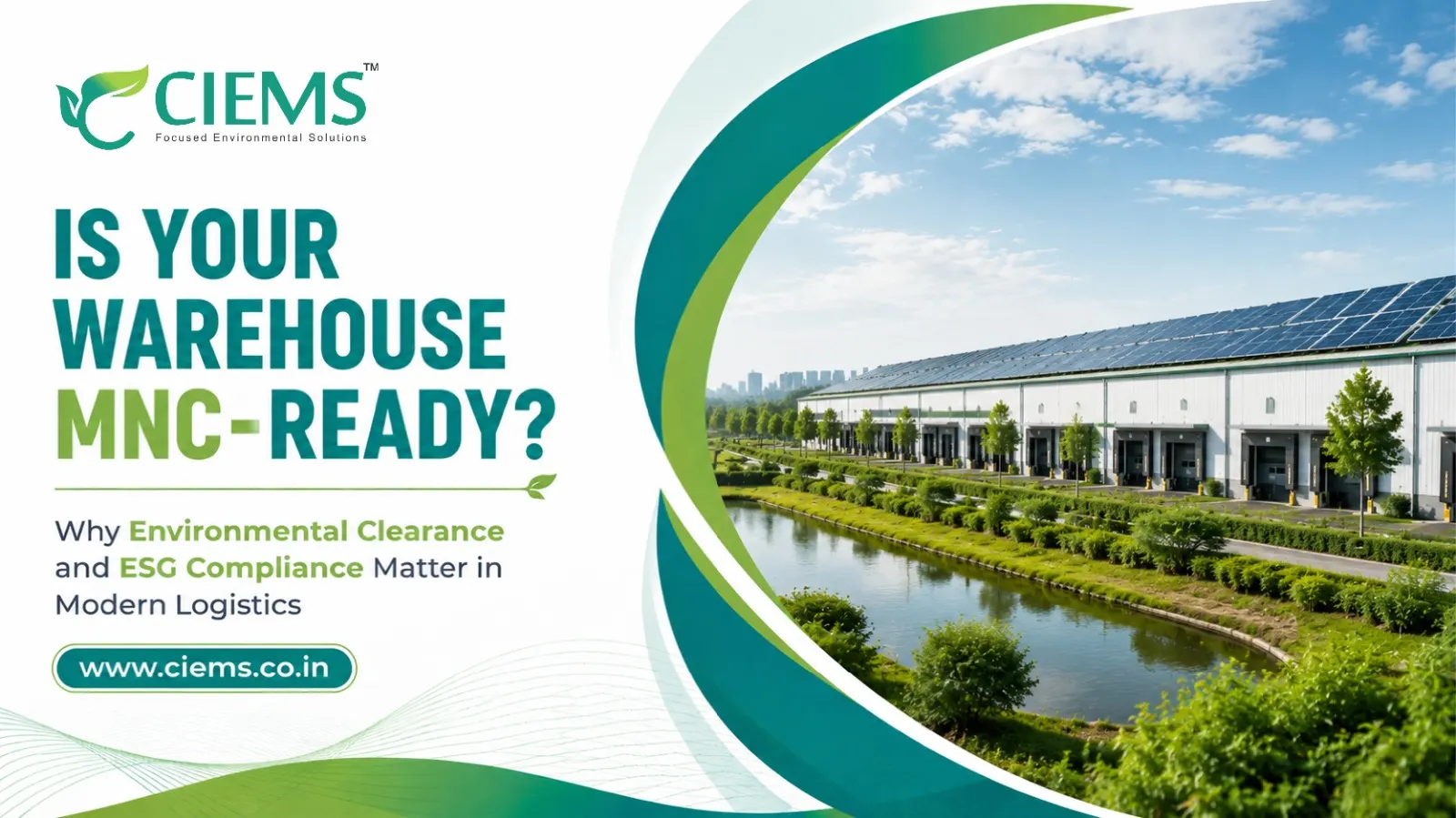
Is Your Warehouse MNC-ready?
The New Standard for Warehousing
Warehousing decisions have changed. Multinational companies, leading Indian manufacturers, e-commerce brands, third-party logistics operators and institutional investors increasingly carry out detailed legal, environmental, safety and ESG due diligence before selecting a facility.
A warehouse may offer excellent connectivity, clear height, floor-load capacity, loading docks and fire systems. However, incomplete statutory approvals or unclear environmental compliance can delay leasing, trigger expensive corrective work or cause a serious prospective tenant to reject the property altogether.
Why Environmental Compliance Matters to MNC Occupiers
Large companies are accountable not only for their own factories and offices, but increasingly for the environmental and governance performance of their supply chains, leased facilities and service partners. Warehouse selection therefore becomes part of broader ESG risk management.
- Legal risk control: Companies prefer facilities that can demonstrate compliance with applicable environmental, planning and building requirements.
- ESG reporting: Water use, wastewater treatment, waste management, energy consumption and emissions may feed into corporate sustainability reporting.
- Business continuity: Properly planned utilities and environmental systems reduce operational disruptions, complaints and enforcement risk.
- Brand protection: A compliant facility helps avoid reputational damage associated with unauthorised construction or poor environmental practices.
- Faster audits: Organised approvals, drawings, test reports and compliance records shorten internal and third-party audit cycles.
- Portfolio consistency: MNCs often apply common global or national standards across multiple warehouses and distribution centres.
Where Environmental Clearance Fits In
Prior Environmental Clearance, where applicable, demonstrates that environmental considerations were assessed at the planning stage rather than added only after construction. The appraisal typically examines how the project will manage resources and environmental impacts during construction and operation.
- Total built-up area, development area and project configuration
- Water demand, source, conservation and reuse strategy
- Sewage generation, treatment capacity and treated-water utilisation
- Solid-waste segregation, storage, processing and authorised disposal
- Storm-water management and rainwater harvesting
- Energy efficiency, renewable-energy provisions and utility planning
- Traffic circulation, parking, loading movement and site access
- Landscape, green area and environmental management measures
What Makes a Warehouse Truly MNC-Ready?
The most reliable approach is to treat the warehouse as a complete compliance package. The physical building and the supporting documentation must tell the same story.
Readiness area | What MNCs typically review | Why it matters |
Land & planning | Title/possession records, land use, sanctioned plan, development permission and completion/occupancy records. | Confirms the project is legally established and matches the approved use. |
Environmental | EC applicability, EC order where required, compliance reports, water balance, STP, rainwater and waste systems. | Reduces regulatory and ESG risk during acquisition or leasing. |
Safety & operations | Fire approvals, emergency access, evacuation, utility systems, parking, loading and worker facilities. | Supports safe, uninterrupted and insurable operations. |
Energy & ESG | Efficient lighting, metering, solar readiness, water reuse, waste segregation and performance records. | Helps occupiers meet sustainability targets and reporting obligations. |
Audit documentation | Approved drawings, licences, test certificates, monitoring records, photographs and renewal tracker. | Allows the tenant to verify compliance quickly and confidently. |
Commercial advantages of an EC-Ready and ESG-Aligned Warehouse
- Faster tenant due diligence and shorter lease-finalisation timelines.
- Access to a wider pool of MNC, listed-company and institutional occupiers.
- Lower risk of last-minute design changes, utility upgrades and environmental retrofits.
- Improved confidence among lenders, investors, insurers and asset managers.
- Better long-term asset positioning as ESG requirements become more structured.
- Clearer responsibility between the developer, owner, facility manager and tenant.
Risks of a Non-Compliant Warehouse
A warehouse that is operationally attractive but poorly documented can become a commercial liability. Typical consequences include:
- Rejection during legal, technical or ESG due diligence
- Delayed possession or rent commencement
- Costly retrofitting of STP, rainwater, waste, fire or utility systems
- Regulatory notices or violation exposure where prior approval was applicable
- Disputes between the owner and occupier over compliance responsibility
- Loss of reputation with corporate brokers, investors and repeat tenants
MNC-Ready Warehouse Checklist
Document / system | Readiness check |
Project approvals | Land use, sanctioned layout, building permission and completion/occupancy status are available and consistent. |
EC screening | A documented applicability assessment has been completed for the exact project configuration. |
Environmental Clearance | Prior EC is available where applicable, and the approved scope matches the constructed/operational facility. |
Water & wastewater | Source, demand, STP capacity, reuse plan and operating records are clearly documented. |
Rainwater & drainage | Storm-water network and rainwater harvesting are installed as per approved planning. |
Waste management | Segregation, storage, disposal tie-ups and records are maintained. |
Energy & utilities | Metering, efficient lighting, DG/solar systems and maintenance records are available. |
Fire & life safety | Applicable fire approvals, emergency plans, access and testing records are current. |
Compliance folder | All approvals, drawings, renewals, test reports and photographs are organised for audit. |
How CIEMS helps Developers and Warehouse Owners
CIEMS supports warehouse, logistics, industrial and area-development projects from early-stage screening through approval and post-clearance compliance. Our aim is to make the project technically practical, regulator-ready and easier for corporate occupiers to evaluate.
- EC Applicability Assessment: Review of project use, built-up area, plot/development area, existing construction, proposed expansion and applicable regulatory framework.
- Design-Stage Environmental Planning: Coordination of water demand, water balance, STP, treated-water reuse, rainwater harvesting, solid waste, energy and green-area provisions.
- Application & Technical Documentation: Preparation of required environmental forms, reports, layouts, KML/site information and supporting technical documents.
- Authority Coordination: Online submission support, presentation preparation, SEAC/SEIAA coordination and response to Additional Details Sought (ADS).
- Post-EC Compliance Support: Condition tracking, compliance documentation, monitoring coordination and support for changes or expansion planning.
- MNC Environmental Readiness Review: A practical gap review of environmental approvals, operational systems and supporting records before tenant due diligence.
Conclusion
The warehouse market is moving from basic space leasing to compliance-driven asset selection. For serious corporate occupiers, environmental readiness is becoming an important part of legal, technical and ESG due diligence.
A warehouse that has been properly screened, planned and documented is more likely to attract quality tenants, complete audits faster and retain long-term commercial value. Environmental Clearance, where applicable, should therefore be treated as a strategic project requirement rather than a last-minute approval.